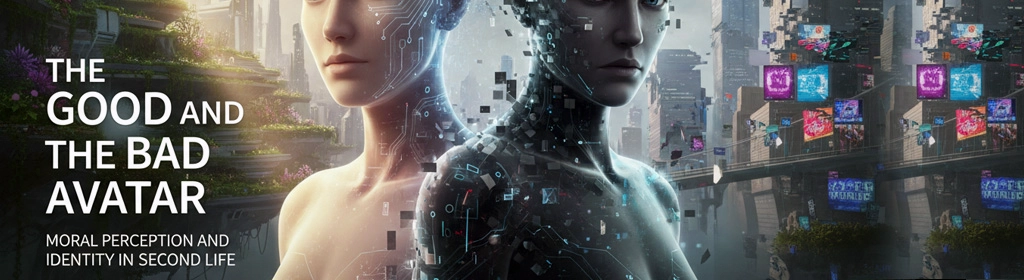
The Good and the Bad Avatar: Moral Perception and Identity in Second Life
In Second Life, players create avatars that represent their digital selves.
These avatars can act freely, explore, socialize, and build lives that often reflect – or contradict – their real-world personalities.
This article explores how avatars are perceived as “good” or “bad,” how attraction and rejection work in this moral space, and why these classifications are always relative. It also discusses how players manage their image, repair their reputation, or avoid confrontation when faced with hostility. Finally, it examines the archetype of the “good player” both scientifically and esoterically , and what it means to be a “good friend” in a virtual world.
The Avatar as a Mirror and a Mask
Every avatar in Second Life is both a mirror and a mask. It mirrors aspects of the player’s personality desires, fears, ideals but it also masks what the player wants to hide.
In psychology, this duality resembles Carl Jung’s concept of the persona: the social face we present to the world. In Second Life, the persona becomes literal a 3D body, a voice, a presence. Yet, because it’s digital, it can be changed instantly. This flexibility makes moral judgment unstable: who is “good” or “bad” when everyone can change shape, name, or gender?
Attraction and Rejection: The Emotional Economy of Virtual Morality
In virtual environments, moral perception often follows emotional patterns rather than logical ones.
Attraction occurs when an avatar radiates empathy, humor, or beauty qualities that trigger trust or admiration.
Rejection happens when the same avatar violates social norms or threatens another’s emotional comfort.
Interestingly, research on online behavior (e.g., Yee & Bailenson, 2007) shows that players project real emotions onto avatars. When someone’s avatar behaves kindly, others feel genuine warmth. When it acts cruelly, the emotional response is equally real. Thus, the moral field of Second Life is emotionally charged and deeply human but also fragile and subjective.
The Relativity of Good and Evil in Virtual Worlds
In Second Life, morality is contextual. A player seen as “bad” in one group may be “good” in another.
For example, a manipulative trader might be hated by idealists but admired by business-minded residents.
This relativity mirrors real-world ethics: good and evil are not absolute but depend on perspective, culture, and intention.
In esoteric terms, Second Life acts as a mirror of the collective unconscious, where players act out archetypes , the hero, the trickster, the healer, the destroyer. Each role is necessary for the balance of the virtual ecosystem.
Managing Perception: From Negative to Positive
When an avatar gains a “bad” reputation, recovery depends on context and audience.
If the other person is open-minded, dialogue and consistent positive behavior can rebuild trust.
But if the other refuses to listen or abuses power , the best strategy is withdrawal, not confrontation.
In virtual worlds, silence can be stronger than argument. Reputation management becomes an art of timing, empathy, and self-control.
The Archetype of the Good Player
The “good player” in Second Life is not one who never makes mistakes, but one who acts consciously.
This archetype combines three dimensions:
- Scientific (psychological) – empathy, cooperation, and emotional intelligence.
- Social (ethical) – respect for boundaries, fairness, and authenticity.
- Esoteric (symbolic) – alignment with higher principles like balance, creation, and compassion.
- In this sense, a “good friend” or “good player” is someone who understands that every avatar is a fragment of the same shared consciousness. To harm another is to harm the collective experience.
Conclusion
In Second Life, being “good” or “bad” is not a fixed label but a fluid narrative one that changes with context, perception, and intention. The world of avatars teaches us that morality is not just about rules but about awareness.
The true mastery of the virtual self lies in knowing when to shine, when to listen, and when to walk away.
Ultimately, every avatar whether angelic or demonic is part of the same human search for meaning, connection, and freedom.