Faith, Dogma, and the Soul of the Avatar in Second Life
Second Life (SL) is often characterized as a playground of hedonism and unrestrained fantasy, yet a parallel, profound current flows through its servers: the practice of religion and the expression of faith. This article examines the phenomenon of “Digital Theology” within the virtual world. Through the scientific lens of hyper-real religion and the esoteric perspective of the “Disembodied Soul,” we explore how users sanctify the pixelated realm. We investigate the paradoxes of virtual sin, the forbidden, the psychological traps of religious roleplay, and the necessity of a “Code of Digital Spirituality.”
The Cyber-Sacred Space: Where the Server Becomes the Temple
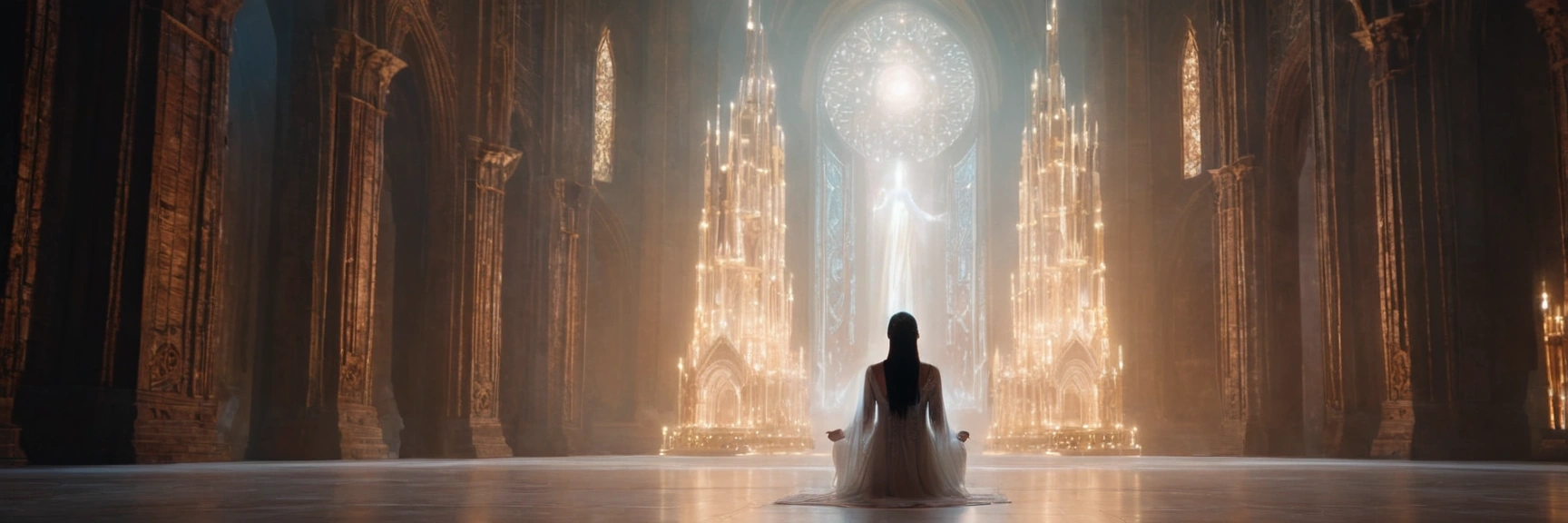
From an esoteric standpoint, space is not defined by physical walls but by intention. When an avatar kneels in a virtual cathedral, lights a pixelated candle, or recites scripture via text chat, they are engaging in an act of will that transcends the medium.
Scientifically, this is known as “Hyper-real Religion.” The environment does not merely simulate reality; it intensifies it. In SL, a believer can construct a replica of Solomon’s Temple with perfect acoustic resonance, walk the Via Dolorosa without the fatigue of travel, or engage in prayer with a global community in real-time. The “lag” of the physical world distance, disability, social anxiety is removed, allowing for a pure, unadulterated flow of spiritual focus.
The avatar ceases to be a puppet and becomes an Icon a vessel through which the divine is accessed. The screen acts as the veil between the material and the digital ether, and in moments of deep worship, that veil dissolves.
The Paradox of the Flesh: Experiences and Limitations
The religious experience in SL is unique because it is purely consciousness-driven, stripped of biological distraction. However, this introduces specific limitations and theological conundrums:
- The Incarnation Paradox: Central to many faiths (particularly Christianity) is the sanctity of the physical body and the physical sacraments (Eucharist, Baptism). In SL, the body is code. Can a digital baptism wash away digital sins? This creates a cognitive dissonance for some believers, leading to a “dual faith” one for the physical body, one for the digital spirit.
- The Fluidity of Divinity: In SL, a user can be a devout Christian in the morning and a high-priestess of a Pagan coven in the afternoon. This fluidity allows for intense comparative religious study but can lead to a dilution of doctrinal commitment. The “soul” becomes a tourist of ideologies.
- The Removal of Consequence: Physical death does not exist in SL. The urgency of mortality the engine of many religious conversions is absent. This forces the digital believer to find motivation in spiritual growth rather than fear of death.
The Forbidden and the “Sins” of the Grid
Just as the physical world has moral laws, the digital world develops its own set of taboos and sins, often mirroring religious dogma but adapted to the code.
- Idolatry of the Avatar (Narcissus Complex): The esoteric trap of believing the created image is superior to the Creator. Spending vast sums of money to make one’s avatar look like a god/goddess, demanding worship from others, or prioritizing the digital aesthetic over spiritual humility is considered a primary sin.
- Desecration of Sacred Space (Griefing): Just as a physical church can be vandalized, virtual religious sites are often targeted by “griefers.” Disrupting a sermon with particle spam, shouting obscenities in a mosque, or using offensive gestures in a temple is viewed by the community not just as harassment, but as a spiritual transgression a violation of the sanctified intention of the space.
- The Sin of Deception: Catfishing within a religious context pretending to be a clergy member or a devout believer to manipulate others emotionally or financially is a grave violation of trust. In an esoteric sense, this is “energy theft,” preying on the hope and faith of others.
Capcane (Traps): The Danger of Simulation
The path of the digital believer is fraught with psychological and spiritual pitfalls.
- The Gnostic Trap: The ancient heresy that the material world is evil and only the spiritual is good can be exacerbated in SL. Believers may begin to withdraw entirely from the physical world, neglecting their families, health, and real-world duties, believing their “real” life is the one on the server. This leads to soul fragmentation.
- The Sanctification of Ego: Finding a community that validates one’s beliefs without challenge can lead to fundamentalism. In the echo chamber of a private religious sim, users may radicalize, developing a “holier-than-thou” attitude that destroys empathy for those outside their digital circle.
- Blurring the Lines (RP vs. Reality): A major trap arises when “Roleplay Religion” is mistaken for genuine faith. Someone may roleplay a dark knight or a demon in one context and a saint in another. The psychological stress of maintaining these contradictory archetypes can lead to dissociation, where the user no longer knows who they are when they log off.
Code of Good Practices: Digital Decalogue
To navigate the spiritual currents of Second Life healthily, the faithful whether RL believers or spiritual seekers should adhere to a code of ethics.
1. The Principle of Grounded Intent
Always be aware of the distinction between the simulation and the sacrament. Use SL to enhance your faith, not to replace your duties in the physical world. Remember that the body is the original temple; treat it with the same care you give your avatar.
2. Respect for the Heterodoxy
Second Life is a pantheon of beliefs. Muslim, Jewish, Christian, Pagan, and Buddhist sims often exist side-by-side. The “Good Practice” here is tolerance. Do not proselytize aggressively in spaces not designated for it. Respect the digital sacred ground of others, even if their theology conflicts with yours.
3. The Ritual of Integrity
If you claim a faith, live by its tenets, even behind the anonymity of the avatar. Anonymity is not a license for immorality. Do not use the “mask” of the game to engage in behavior your physical conscience would forbid. “God sees the IP address” is a modern metaphor for the omnipresent witness.
4. Boundary of Energy
Recognize that emotional manipulation is easy in text-based environments. Be wary of “gurus” or “leaders” who demand too much of your time or resources. A true spiritual guide empowers you; a false one enslaves you.
5. The Sabbath of the Screen
Just as the physical body needs rest, the digital spirit needs silence. Log off. Practice silence and meditation away from the hum of the computer. True revelation often comes not in the pixels, but in the space between them.
Conclusion
Religion in Second Life is not a game; it is a testament to the human need for meaning. Whether viewed as a sociological experiment in community building or an esoteric projection of the collective soul, the digital faithful are proving that the sacred can inhabit any space, provided there is a human heart to perceive it. By avoiding the traps of ego and dissociation, and adhering to a code of integrity, the virtual world can become a genuine extension of the spiritual journey.