The Dorian Gray Syndrome: Aging in Real Life vs. Eternal Youth in SL
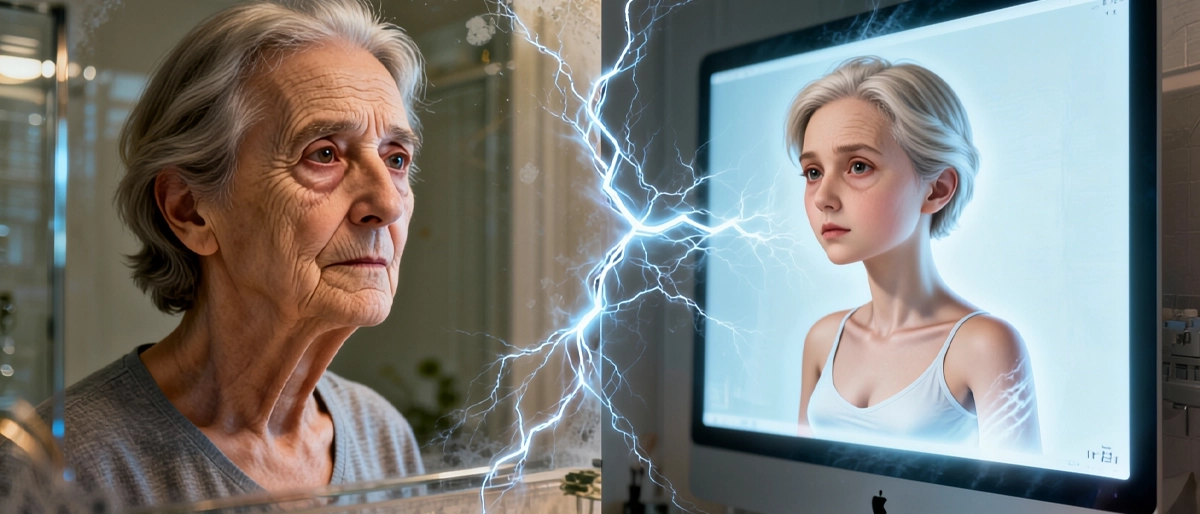
Oscar Wilde’s The Picture of Dorian Gray presents a haunting premise: a man remains eternally young while his portrait hidden in the attic grotesquely ages. In the era of Second Life (SL), this fiction becomes a technological reality. This article investigates the psychological impact of maintaining a youthful avatar against the backdrop of biological aging. We analyze the cognitive dissonance between the reflection in the bathroom mirror and the digital projection on the screen, exploring whether this digital fountain of youth is a tool for psychological preservation or a maladaptive denial of mortality.
Introduction: The Portrait in the Attic
In Wilde’s novel, the painting bears the “sins” and the years of the protagonist, allowing Dorian to live a life of superficial beauty. In Second Life, the avatar functions as the reverse of this metaphor: the digital self remains pristine wrinkle-free, energetic, and sexually viable while the biological user inevitably succumbs to entropy.
This creates a unique psychological schism. For the first time in human history, the elderly can “wear” the skin of the youth seamlessly, interacting socially as peers with a generation biologically younger than their own children. The question arises: When the mind inhabits a young body daily, does the internal clock reset, or does the return to reality become a daily trauma?
The Scientific Perspective: Dissonance and the “Digital Prosthesis”
- The Dorian Gray Syndrome (DGS)
While not a formally recognized psychiatric diagnosis, the term “Dorian Gray Syndrome” describes a cultural phenomenon involving extreme resistance to aging, often manifesting through cosmetic surgery and narcissism. In SL, this syndrome takes a digital form. Users invest heavily in the appearance of their avatars to maintain an idealized self-image.
Unlike cosmetic surgery, which has physical limits and risks, digital modification is effortless and perfect. This ease can exacerbate Body Dysmorphic Disorder (BDD) in the reverse: the user becomes alienated from their biological form. The biological body begins to feel like a “broken suit” or a “dilapidated house” that the spirit is forced to inhabit when the computer is turned off.
- Cognitive Dissonance and the “Mirror Shock”
The core psychological tension lies in the transition moments. The “bathroom mirror” represents the harsh truth of biology (sagging skin, graying hair, reduced mobility), while the “computer screen” represents the preserved ideal.
This creates a state of cognitive dissonance a mental discomfort experienced by a person who holds two or more contradictory beliefs or values.
Belief A (Digital): “I am vibrant, attractive, and capable.”
Belief B (Biological): “I am aging, limited, and fading.”
To resolve this dissonance, the user may withdraw further into the virtual world, treating the physical body merely as a life-support system for the consciousness that “lives” in SL. However, studies also suggest a positive counter-effect: The Proteus Effect. Older users with young avatars often report higher self-esteem and cognitive agility. By “acting” young, they may delay some psychological aspects of aging, proving that the mind can influence the body’s vitality even if it cannot reverse the clock.
The Esoteric Perspective: The Temporal Body vs. The Eternal Spirit
From a metaphysical standpoint, the conflict between the aging body and the ageless avatar is a modern reenactment of ancient gnostic dualism.
- The Trap of the “Subtle Body”
In esoteric traditions, humans possess multiple layers of being: the physical body (which decays) and the subtle or astral body (which is malleable and survives death). Second Life could be viewed as a technology that allows the user to consciously manipulate their “astral form.”
However, the danger lies in attachment. In Buddhism, attachment to form is the root of suffering. By freezing the avatar in a state of eternal youth, the user creates a “bardo” a liminal space where time stands still. While the physical body marches toward death, the digital consciousness stagnates in a loop of perpetual youth. This denies the soul the wisdom that comes with aging the archetypal journey from the Puer Aeternus (Eternal Youth) to the Senex (the Wise Old Man).
- Denial of the Cycle
The refusal to age in SL can be seen as a rejection of the natural cycle of life, death, and rebirth. In the mystery traditions, the Crone and the Sage are figures of immense power and knowledge. By refusing to don the digital wrinkles, users may be unconsciously rejecting the accumulation of spiritual authority that comes with age. They remain trapped in an endless puberty of the soul, prioritizing aesthetic beauty over the deepening of the spirit.
Yet, conversely, there is a valid esoteric argument for the Timeless Self. If the soul is indeed eternal and ageless, the young avatar might actually be a more accurate representation of the energetic self than the aging biological shell. The avatar, in this view, is not a lie, but a revelation of the spirit’s true, undying nature.
Synthesis: The Double-Edged Mirror
The impact of the “Dorian Gray effect” in Second Life depends entirely on the user’s level of awareness.
- The Path of Dissonance: If the user uses the avatar to escape the reality of their biological timeline, they set themselves up for a profound depression. When the screen goes black, the silence of the room and the creaking of the joints become unbearable. The “portrait” in the attic (the real body) becomes a source of horror.
- The Path of Integration: If the user recognizes the avatar as an expression of their inner vitality rather than a replacement for their physical reality, the dissonance vanishes. They can be “old” in wisdom and biology, yet “young” in creativity and digital expression.
Conclusion
We are entering an era where the map has become more important than the territory. The discrepancy between the aging face in the mirror and the flawless face on the screen is a test of psychological resilience.
Are we escaping the inevitable, or are we proving that consciousness is not bound by time? The Dorian Gray of the 21st century does not hide a painting in the attic; he logs out of a server. But unlike Wilde’s tragic hero, the modern user has a choice: to let the digital youth enhance the remaining years of life, or to let it mock the inevitable decay. The goal is not to remain forever young, but to age with the grace of a spirit that knows it is more than the sum of its pixels.