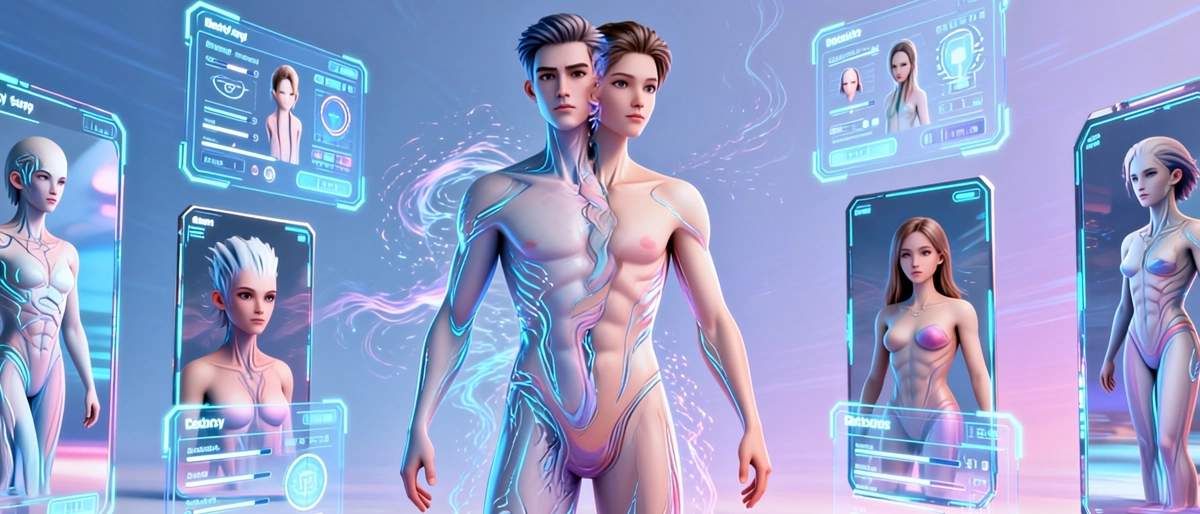
Beyond Gender: The Fluidity of Identity in Second Life
In the physical world, gender is often inextricably linked to biological sex, creating a rigid framework for identity. Second Life disrupts this paradigm by decoupling the avatar’s form from the user’s biology. This article examines the phenomenon of “gender-switching,” analyzing whether it represents a fleeting curiosity or a profound exploration of the self. By synthesizing social psychology with esoteric traditions of the soul, we explore how a world without biological constraints redefines the very nature of gender
The Uncoupling of Flesh and Spirit
Biological reality acts as a fundamental constraint: we are born into a body, and that body dictates a social script. Second Life (SL) offers a radical departure a digital tabula rasa where the “meat” is left behind. When a user chooses an avatar of the opposite gender, they are not merely changing a texture on a screen; they are engaging in a complex psychological and spiritual experiment.
Is this gender-switching a simple act of deception or play? Or is it the externalization of a latent internal truth? The answer lies in the tension between the social performance of gender and the archetypal essence of the soul.
The Scientific Perspective: Performance and the Proteus Effect
- The Social Construction of Gender
Sociologist Judith Butler famously argued that gender is not something we are, but something we do a performance regulated by social norms. In the physical world, these performances are policed by biology and societal expectation. In SL, the stage changes.
Without the biological consequences (fear of violence, hormonal judgment, physical limitations), users are free to “perform” the opposite gender. Research indicates that for many, this is not about fetishization, but about cognitive empathy. By walking in the digital shoes of another gender, users deconstruct the social norms they have internalized. They learn how differently they are treated how a female avatar might be harassed or courted, or how a male avatar might be ignored or respected revealing the harsh inequalities of the physical world.
- The Proteus Effect and Behavioral Conformity
The Proteus Effect plays a crucial role here. Studies (Yee et al.) have shown that users conform to the stereotypes associated with their avatar’s gender.
A male user in a female avatar may adopt a more polite, less aggressive communication style, influenced by the visual cue of their own digital form.
Conversely, a female user in a male avatar might stand closer to other avatars or adopt more dominant postures.
This suggests that gender-switching is more than curiosity; it is a behavioral immersion. The user isn’t just looking like the opposite sex; their psychology is literally reshaping to fit the digital vessel. For transgender individuals, this often serves as a critical therapeutic “sandbox” a safe space to test the waters of their true identity before transitioning in the high-stakes reality of the physical world.
The Esoteric Perspective: The Androgyne and the Anima/Animus
If science explains the behavior, esotericism explains the longing behind it.
- The Anima and Animus (Jungian Psychology)
Carl Jung posited that every man possesses an unconscious feminine aspect (the Anima), and every woman possesses a masculine aspect (the Animus). In the rigid binary of the physical world, these aspects are often repressed into the Shadow Self.
Second Life acts as a tool for Shadow Integration. When a man creates a female avatar, he is not betraying his masculinity; he is projecting his Anima outward, giving her form and voice. This dialogue with the internal opposite allows for a wholeness that is rarely achieved in mundane life. The avatar becomes a vessel for the unlived life within the psyche.
- The Archetype of the Divine Androgyne
Ancient alchemical and spiritual traditions often speak of the “Rebis” or the Divine Androgyne a being that has transcended the duality of male and female to become whole. Many spiritual paths argue that the soul itself has no gender; gender is a property of the biology, not the spirit.
In this context, gender-switching in SL is a form of digital gnosis. By experiencing both polarities, the user moves closer to a state of non-duality. The digital world strips away the “garments of skin” (a term used in Kabbalah to describe the physical body) and allows the user to play with the “garments of light.” The avatar becomes a fluid expression of a consciousness that refuses to be categorized.
The Social Angle: A World Without Biological Consequences
The unique social architecture of SL creates a space where the “gender binary” is not enforced by nature, but by choice.
The Death of the “Essentialist” Norm: In the physical world, gender is often treated as essential (“Boys will be boys”). In SL, gender is revealed as fluid. A user can be a male warrior in the morning and a female fairy in the evening. This fluidity forces other users to abandon their assumptions. You cannot assume the biology of the operator based on the avatar.
Trust and Deception: There is a social stigma attached to “gender-bending” by those who view it as deception. However, from an esoteric viewpoint, the “lie” of the avatar often reveals a “truth” of the personality that the biological body conceals. The social friction occurs when users demand that the digital world mirror the biological one a demand that the medium itself fundamentally rejects.
Conclusion
Is gender-switching in Second Life mere curiosity? For some, perhaps. But viewed through a wider lens, it is a rehearsal for immortality. As we move toward a future where consciousness may increasingly inhabit non-biological forms (AI, androids, VR), the rigid lines of gender will inevitably blur.
In the digital realm, we return to the primordial state of the soul: fluid, malleable, and free from the heavy anchor of the flesh. When we change our gender in the metaverse, we are not just playing a character; we are answering a deeper call to integrate the fragmented parts of our own being, proving that we are not our bodies, but the architects of our own identity.