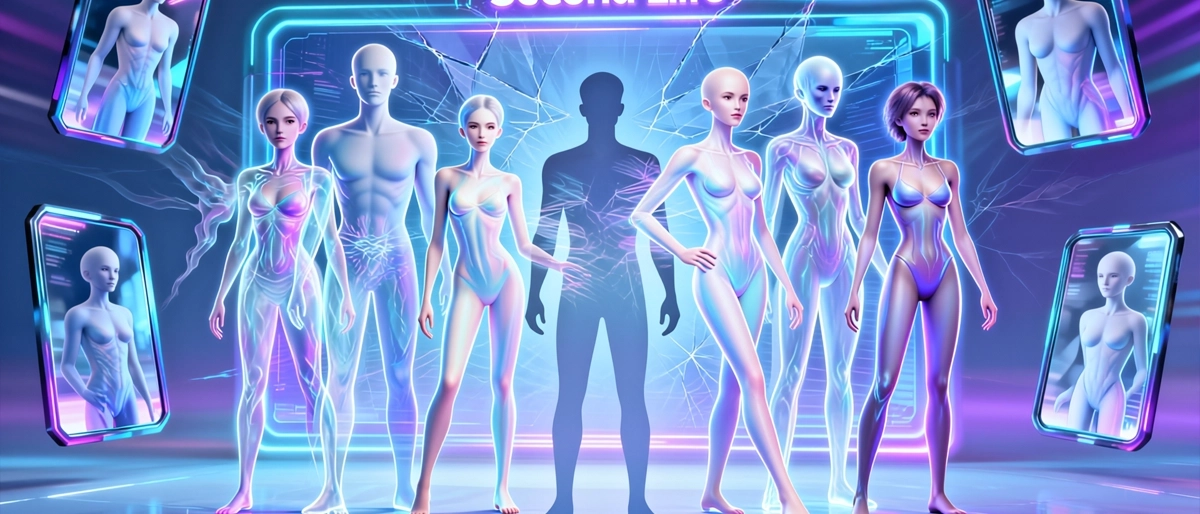
The SL Avatar as Ideal: Who We Are When No One Knows Our Face
In the era of the metaverse, the boundaries between the biological self and the digital self are dissolving. Second Life, as a pioneer of virtual worlds, offers fertile ground for the study of self-discrepancy. This article explores how modifying the physical parameters of an avatar activates the Proteus Effect, transforming not only social interactions but also the intimate structure of the user’s psyche. When the mask becomes more perfect than the face, who does the wearer become?
Introduction: The Mirror Without Reflection
In classical mythology, Narcissus falls in love with his own image reflected in the water an inaccessible image, an illusion that becomes his tomb. In the 21st century, Second Life offers an “inverted mirror”: we do not look at a passive reflection of reality, but actively construct a projection. This is not merely a digital disguise, but an ontological experiment.
When a user creates an avatar, they are not just making an aesthetic design choice; they are answering an esoteric question as old as time: If I could eliminate biological limits, who would I choose to be? The answer to this question reveals the deep psychological mechanisms of self-discrepancy.
The Scientific Perspective: Self-Discrepancy and the Proteus Effect
- Self-Discrepancy Theory
Psychologist E. Tory Higgins theorized the existence of three domains of the self:
- The Actual Self: The attributes a person believes they currently possess.
- The Ideal Self: The attributes a person would like to possess (hopes, aspirations).
- The Ought Self: The attributes a person believes they should possess (obligations, responsibilities).
In daily life, the discrepancy between the Actual Self and the Ideal Self generates feelings of disappointment and dissatisfaction. Second Life, however, offers an instant remedy: the reduction of this discrepancy through digital editing. If in reality a user feels introverted and insignificant, in the virtual environment they can become tall, athletic, and charismatic. This sudden alignment between virtual reality and the psychic ideal produces a transitory euphoria, a validation of unrealized potential.
- The Proteus Effect
Named after the Greek god Proteus, capable of changing his shape at will, this phenomenon was documented by researchers Nick Yee and Jeremy Bailenson (2007). The Proteus Effect describes how people change their behavior depending on the characteristics of their avatar, regardless of who they are in reality.
Studies have demonstrated that:
- Height: Users assigned taller avatars tend to negotiate more aggressively and with greater confidence, reflecting the social stereotype of dominance.
- Attractiveness: Those with socially attractive avatars become more open, friendly, and bold in intimate interactions.
- Age: Aging the avatar can lead to more mature behavior or, conversely, a melancholic withdrawal.
- Thus, the digital body is not a mere receptacle, but a behavioral actuator. By modifying appearance, we alter the chemistry of our decisions. The user does not “pretend” to be confident; they become confident because the environment validates their new form.
The Esoteric Perspective: Sympathetic Magic and the Thought-Form
If psychology explains the mechanism, esotericism explains the substance of this transformation.
- The Avatar as Tulpa or Golem
In Tibetan traditions, a Tulpa is an entity created through intense concentration of the mind, which gains autonomous form. The avatar in Second Life is a collective and technological tulpa. It is an externalized “thought-form.”
The user performs an act of sympathetic magic: Like attracts like. By creating an ideal form, the user attempts to attract into their virtual reality energies (social attention, admiration, love) that they do not access in the physical plane. The avatar becomes a vessel for “Desire,” a digital idol to which the sacrifice of time and conscious attention is offered.
- The Death of the Biological Ego and Digital Rebirth
The paradox of Second Life is that the “second life” often becomes the place where the authentic Self (in the Jungian sense) surfaces, while the persona worn in the real world is the one that dies.
When a user chooses to become non-human (a “Furry,” an elf, an androgynous creature), they reject their biological condition (genetic karma). This is a form of spiritual transhumanism. The removal of the recognized face (“when no one knows our face”) allows the soul to speak through masks. In shamanic tradition, the priest wears a mask to become the respective spirit. In Second Life, the user wears “pixels” to become the Archetype they feel within.
Synthesis: The Feedback Loop Between Worlds
Here lies both the danger and the opportunity. There are two outcomes of this discrepancy:
Destructive Compensation: The user invests all their psychic energy into the avatar (the Ideal Self), allowing the biological body and real life to degrade. The discrepancy becomes an abyss. The avatar is fed, while the biological human dies of emotional starvation.
Therapeutic Integration: The Proteus Effect is used as a “psychological prosthesis.” A user who learns to be assertive in the skin of a powerful avatar can migrate this behavior (“skill transfer”) into the real world. The avatar becomes a springboard for the evolution of the real self, not a substitute.
Conclusion
Second Life is not just a game; it is an extension of the human psyche, a laboratory of the soul. When we modify the physical parameters of an avatar, we are not just changing 3D textures, but altering the frequency at which we vibrate in the social field.
The Proteus Effect demonstrates that “form precedes substance”: we become what we appear to be. And in this space where no one knows our face, we are, finally, alone with our ideal, confronted with the terrifying freedom to be anything, yet incapable of being everything at once. The avatar is our ideal made visible a phantasm waiting for us to catch up to it, or to be caught by it.