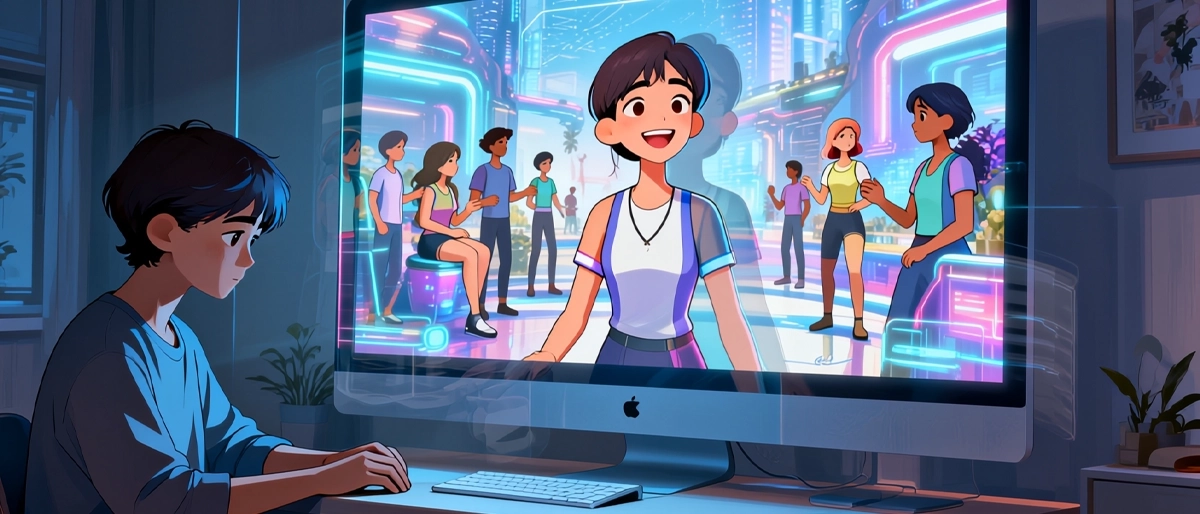
Loneliness in Two Worlds: How SL Affects the Social Life of Introverts
For individuals with social anxiety or introverted tendencies, the physical world often presents a landscape of friction and fear. Second Life (SL) offers a sanctuary where social interaction is mediated by a screen and an avatar. This article examines whether this virtual refuge serves as a training ground for social development or a gilded cage that exacerbates isolation. By analyzing the “online disinhibition effect” alongside esoteric concepts of spiritual bypassing, we explore the delicate balance between connection and escapism.
The Silent Paradox
We live in an era of “connected isolation,” where digital tools promise to bridge the gap between souls but often widen the chasm within the individual. For the introvert or those suffering from social anxiety Second Life presents a unique proposition: a world where the terror of physical presence is removed.
The paradox lies in the title: “Loneliness in Two Worlds.” A user may be surrounded by friends in a virtual jazz club, their chat box scrolling with laughter and conversation, yet physically sit alone in a dark room. The question is not whether SL cures loneliness, but whether it changes its nature.
The Scientific Perspective: Disinhibition and the Safety of the Screen
- The Online Disinhibition Effect
Psychologist John Suler coined the term “Online Disinhibition Effect” to describe how people behave differently online than they do in person. For introverts, this is primarily “Benign Disinhibition.”
- The Removal of Threat: In real life, an introvert is hyper-aware of non-verbal cues a frown, a shift in posture, a silence that signal rejection. In SL, these stressors are minimized or removed. The avatar does not blush, sweat, or stutter.
- The Control of Time: Text-based communication allows the introvert to pause, edit, and curate their response. This control reduces the anxiety of “saying the wrong thing.”
- Social Skills Training or Avoidance?
There are two competing hypotheses regarding the effect of SL on social skills:
The Social Compensation Hypothesis: This theory suggests that SL helps introverts “catch up.” By practicing social interactions in a low-risk environment, they build confidence that can eventually transfer to the real world (the “skill transfer” effect). They learn the rhythm of conversation and the joy of connection.
The Rich-Get-Richer Hypothesis: Conversely, this theory posits that those who are already socially adept use the internet to enhance their networks, while those with social anxiety use it to replace real-world interaction.
The danger arises when the safety of the screen becomes an addiction. The user may develop a reliance on the avatar as a shield. The fear of re-entering the physical social sphere grows as their virtual life flourishes, creating a widening gap between their digital competence and biological fear.
The Esoteric Perspective: The Hermit and the Illusion of Company
From a spiritual viewpoint, the introvert’s journey is often pathologized by a society that prizes extroversion. However, esoteric traditions value solitude as a crucible for the soul.
- The Archetype of the Hermit vs. Spiritual Bypassing
In Tarot, The Hermit represents necessary isolation a withdrawal from the world to find inner wisdom.
- The Sanctuary: For the spiritually inclined introvert, SL can act as a modern monastery. It allows them to retreat from the overwhelming sensory input of the physical world to focus on intellectual or spiritual communion.
- Spiritual Bypassing: However, the shadow side of the Hermit is escapism. “Spiritual bypassing” occurs when spiritual practices (or in this case, virtual existence) are used to avoid facing unresolved psychological wounds. If SL is used to hide from the “karma” of physical life confronting one’s shadow, dealing with rejection, learning to be vulnerable in the flesh then it becomes a prison. The user is not a Hermit seeking wisdom, but a fugitive fleeing life.
- The Energetics of Distance
Esotericism teaches that physical proximity carries a dense, transformative energy. To be in the room with another person is to experience their “aura” the raw, unedited vibration of their being.
- The Filtered Soul: In SL, the connection is intellectual and emotional, but it is “filtered.” It lacks the friction of the physical. While this is comfortable, it is incomplete. The introvert in SL may feel they have found their “tribe,” yet they are engaging only with the minds of others, not their total being.
- The Illusion of Control: The introvert often craves control. SL offers total control over the environment. But spiritually, growth often comes from the loss of control. By sanitizing the social experience of all friction, the user may be robbing themselves of the spiritual muscle growth that comes from awkward, messy, physical reality.
Synthesis: The Bridge Between Worlds
The impact of SL on the introvert depends entirely on intent.
- The Trap: If the user views SL as a permanent replacement for physical reality, they risk a specific form of melancholia the sadness of living in a paradise you can never touch. The “screen safety” becomes a wall that keeps people out, not a window that lets them in.
- The Tool: If the user views SL as a bridge, it can be therapeutic. It allows the introvert to experience “radical acceptance” being liked for their mind and soul without the judgment of their physical shell. This experience can be healing, proving to the anxious mind that connection is possible.
Conclusion
Second Life is neither a cure for social anxiety nor a guaranteed path to isolation. It is a crucible.
For the introvert, the avatar is an exoskeleton a protective shell that allows a soft creature to survive in a harsh environment. But exoskeletons have a limit: they do not grow. Eventually, the shell must be molted. The challenge for the lonely user is to recognize when the virtual world has served its purpose to teach them that they are worthy of connection and to carry that truth back into the noisy, terrifying, and beautiful world of flesh and bone. The goal is not to find a home in the machine, but to remember that the machine is only a temporary shelter.