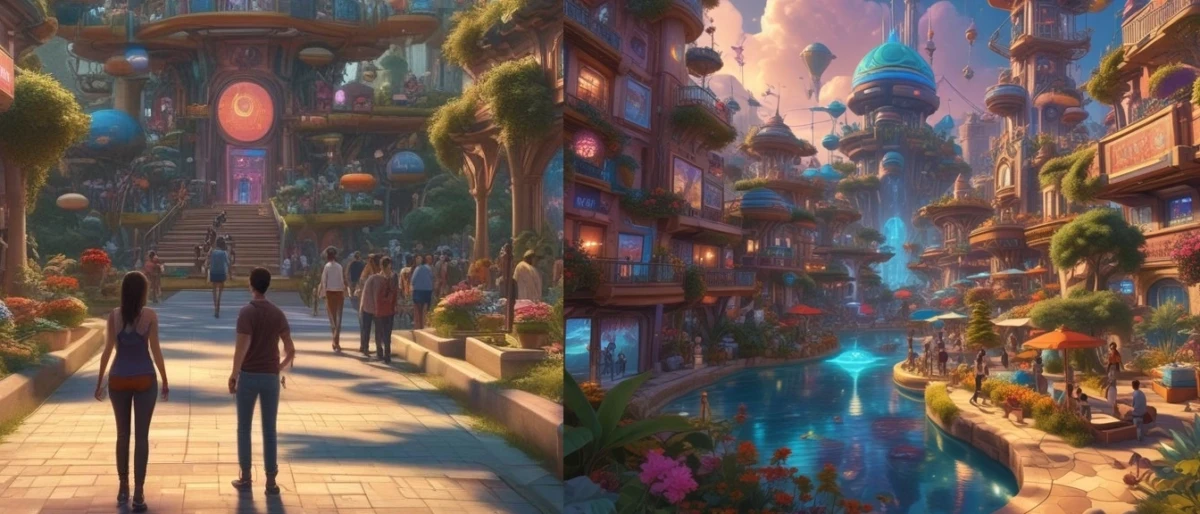
Second Life Between Simulacrum and Reality
Second Life represents a singular point in digital history: a world without competitive objectives, a social “sandbox” where the only limit is imagination. This article investigates the diffuse boundary between psychic projection and tangible reality, the mechanisms by which the virtual environment substitutes fundamental human needs, and the risks of transforming a tool for evolution into a golden cage.
The Specifics of the Game and the Parallel with Real Life
The Scientific Perspective:
Unlike classic video games (MMORPGs), which have a structure based on levels, points, and external goals, Second Life is an open social simulation medium. There is no “winning” or “losing.” This lack of structure forces the user to create their own structure, mimicking Real Life (RL): economy, property, relationships, art. It is a real-time sociology laboratory where social norms can be tested without physical consequences.
The Esoteric Perspective:
SL is a technological astral plane. In the Hermetic tradition, the principle “As above, so below” applies here inversely: as it is in the soul (below), so it is projected into the virtual world (above). The avatar is a digital “golem,” a thought-form given life through the user’s attention. The parallel with real life is striking because SL does nothing but reflect the content of the collective and individual unconscious, removing physical constraints (gravity, death, old age), leaving only the essence of will.
Reality vs. Fiction: Where Does the Dream End?
How much is reality?
From a neurological standpoint, emotion is 100% real. Studies using brain imaging (fMRI) show that the same brain areas activate when a user is socially rejected in an online game as when they are rejected in reality. Thus, although the medium is fictional (binary code, pixels), the subjective experience and hormonal impact (oxytocin, cortisol) are real.
How much is fiction?
Fiction lies in the perception of identity. In SL, the user has total control over the external variables of the self. This is the “Fiction of Control.” What seems real is an idealized construction.
Synthesis:
Second Life is a Hyper-Reality (Jean Baudrillard’s concept). It becomes more real than reality itself because it is cleansed of the dirty or boring aspects of biological life. It is a fiction that becomes psycho-social reality.
Substituting Real Needs and the Limit of Harmfulness
Substituting Needs:
- Need for Belonging: SL is a powerful remedy for loneliness. It offers niche communities where every “outsider” finds their tribe.
- Need for Competence and Self-Actualization: People who are socially or economically blocked in real life can become entrepreneurs, content creators, or community leaders in SL. This substitutes the need for utility and validation.
When does it become Harmful?
It becomes harmful when the function of compensation turns into evasion.
- Scientifically: A syndrome of dissociative detachment appears. The user begins to neglect hygiene, sleep, job, or family in RL to keep the avatar “alive.” Addiction sets in when virtual rewards (Linden Dollars, virtual relationships) take priority over real ones.
- Esoterically: “Reverse vampirism” occurs. The user squanders their vital energy (prana) into an illusory construction. A rupture is created between soul and body; the soul prefers the digital world and refuses to “descend” into the responsibilities of physical life. This is a form of “shackling the soul” by its own mental creation.
The Beneficial Triad: Healing, Learning, Relaxation
- Healing through Play (Avatar Therapy)
Scientific: SL is used in therapy for social anxiety, autism (Asperger’s syndrome), and phobias. Patients can practice social interactions in a safe environment where the risk of failure is controlled. It is a form of “gradual virtual reality exposure.”
Esoteric: It is “Shadow Work Healing.” The user can project repressed parts of their personality (e.g., a shy person can project a dominant avatar) and explore these aspects in a safe environment, thus integrating them into consciousness. - Learning through Play
Scientific: SL functions on the principle of “learning by doing.” Universities use SL to simulate physical phenomena, architecture courses, or foreign languages. Creating content (LSL scripting, building) develops algorithmic thinking and real technical skills.
Esoteric: It is the modern “Mystery School.” The user learns the laws of causality in an environment that reacts instantly to intention. You learn that the outer world (virtual) is a direct reflection of the inner one, a fundamental lesson for real life. - Relaxation through Play
Scientific: The state of “Flow” is reached quickly when the user explores spectacular visual environments or creates. This reduces cortisol and provides a healthy escape from daily stress.
Esoteric: It is “Active Meditation.” Virtual flight (a common feature in SL) and the ambient music in sims can induce altered states of consciousness similar to lucid dreaming, allowing the mind to reset. - Conclusion
Second Life is a double-edged sword. It is a psychological exoskeleton that can support and heal a fragile spirit, but it can also become a digital prison that cancels motivation for real life.
True mastery lies not in choosing between SL and RL, but in using the virtual experience as a training ground. If you learn to be empathetic, creative, and courageous in the virtual world, those qualities must be transferred to the real world. Only then does the game fulfill its purpose: that of being a branch of the tree of life, not a root cut off from the soil.