Study on Management: The “Nomadic Performer” Model in Second Life
- The Group Dynamic: The “Pied Piper” Model
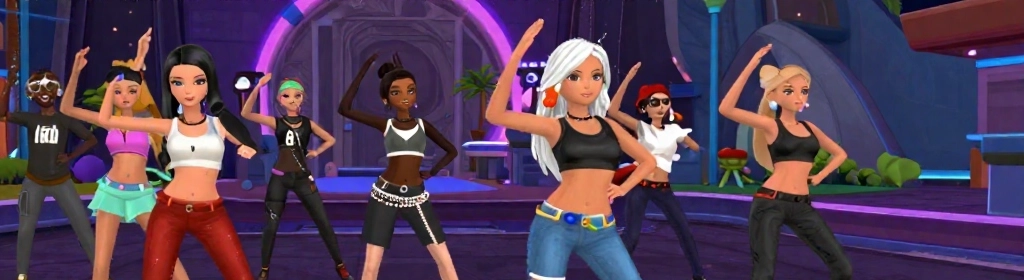
This study addresses a specific type of ad-hoc multinational group: A centralized, nomadic performance collective.
In this model, the power structure is vertical regarding the performance (The Leader controls the HUD, the moves) but horizontal regarding the identity (Participants control their appearance, the destination and social interactions).
The Leader (The Pilot): Holds the technical authority. They control the dance HUD, effectively acting as the choreographer and the DJ’s interpreter.
The Participants (The Entourage): They have no control over the dance moves but retain full autonomy over their avatar’s aesthetic (costumes, style, colors). They decide together when the group moves to a new club. They are passive executors of the dance but active creators of the visual spectacle and where to travel.
- Motivations: Why Do Users Join and Leave?
Understanding the “Flow” of the human element is crucial for sustainability.
A. Motivations for Joining (The “Pull” Factors)
- Effortless Perfection: Dancing well in Second Life requires expensive HUDs , time to learn how to dance, and rhythmic timing. By joining this group, users gain access to high-quality, synchronized animation without needing to own the tools or possess the skills. They “look good” instantly.
- The “Clan” Effect (Social Identity): Humans have an innate need to belong. Wearing the group tag and moving as a unit creates a strong sense of identity. They are no longer “a lonely avatar in a club”; they are part of a “Show.”
- Curated Exploration: The Leader acts as a curator. Participants join to be led to “where the good music is” without having to search for landmarks or teleport aimlessly.
- Social Safety Net: Entering a club alone can be intimidating. Entering with a group provides a safety net. They have a built-in social circle (group chat) immediately upon arrival.
B. Motivations for Leaving (The “Push” Factors)
- Aesthetic Dissonance: If the group moves to clubs that consistently play music the participant dislikes, they will drift away. The Leader’s music taste becomes the group’s retention rate.
- Passive Fatigue: Without the ability to lead or influence the dance, some participants may feel “used” or bored. If they are strictly feel us puppets, the novelty wears off.
- Schedule Mismatch: Being multinational, if the Leader dances during hours when a segment of the group is asleep or working, those members will eventually remove the group tag.
- Drama or Silence: If the group chat becomes silent (lack of connection) or toxic (drama), the social bond breaks, and the primary reason for staying vanishes.
- Management Strategies: Governance in a Fluid World
Given the fluid nature (free entry/exit) and the multinational composition, rigid corporate rules are counterproductive. The management style must be “Benevolent Anarchy with a Core.”
A. Rules vs. No Rules: The Minimalist Approach
Recommendation: Strict rules will kill this group. The appeal is “freedom within the safety of the group.”
- The “No Drama” Rule: This is the only non-negotiable rule. Since the Leader holds the power (HUD), challenging the Leader’s choices (e.g., “I don’t want to go to this club”) creates friction. The “No Drama” policy implies: Trust the Leader’s destination, or leave quietly.
- The Costume Guideline (Not Rule): Instead of “Everyone wear red,” suggest “Wear something fiery” or “Cyberpunk theme tonight.” This allows participants to express their personality while maintaining group cohesion.
B. Managing the Leader’s Burden
The Leader risks burnout because the group depends entirely on them.
- Delegation of Vibe: The Leader handles the technicals; the participants handle the vibe. The Leader should encourage participants to hype each other up in chat.
- The “Open Door” Policy: The Leader must not take it personally when people leave. In a multinational, ad-hoc group, turnover is a feature, not a bug. “Come when you want, leave when you want” reduces the pressure on the Leader to “retain” members.
C. Communication and Relationships
The Group Chat: This is the glue. The Leader must occasionally participate, but the chat should ideally be a peer-to-peer space where participants form bonds independent of the Leader.- Language Barriers: As a multinational group, keep instructions simple. Use gestures or emotes if language becomes a barrier.
- The “Show” Experience: Balancing Control and Autonomy
The success of this specific model relies on how the Leader handles the “Pilot” role.
- Adaptability: The Leader must “read the room.” If the group is in a romantic club, the HUD should switch to slow dances or elegant waltzes. If in a club, high-energy moves. If the Leader forces incongruent styles (e.g., breakdancing in a jazz lounge), the immersion breaks, and participants leave.
- Visual Cohesion: Since participants choose their clothes, the Leader creates the spectacle through Formation. Using the HUD to make the group form a circle, a line, or a cluster makes the disparate costumes look like a deliberate artistic choice.
- Conclusion: The Art of the “Fluid Collective”
Managing this type of group is less about “management” and more about “Hosting.”
The Leader is a host taking guests on a tour. The participants are guests who can dress as they please and talk to whom they please, but they must follow the host to the next destination.
Key to Success:
- Trust: Participants must trust the Leader’s musical and choreographic taste.
- Inclusion: The chat must be welcoming to all languages and cultures.
- Freedom: No obligations. No mandatory attendance. No strict uniforms.
- By maintaining a “No Drama” environment and high-quality destinations, the group becomes a sanctuary. It offers the best of Second Life: the social connection of a community and the visual thrill of a performance, without the heavy responsibilities of a traditional roleplay guild or competitive team.