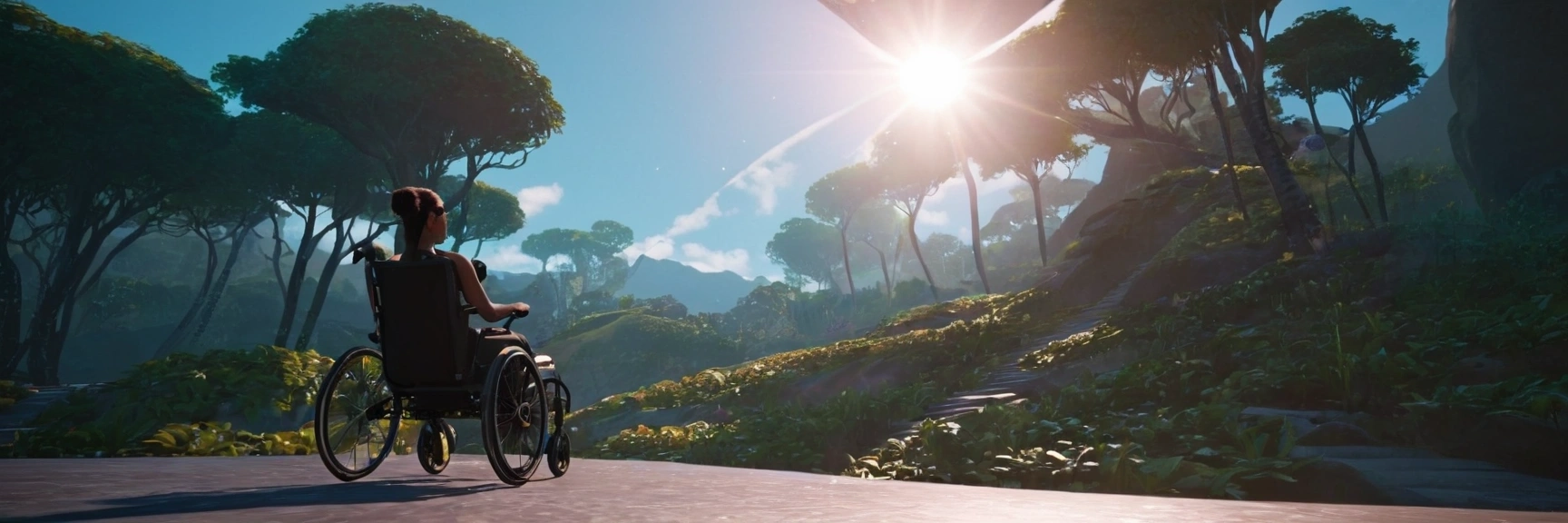
Physical Disability in Second Life Game The Science and Esotericism
Second Life (SL) serves as a unique sociotechnical phenomenon where the laws of physics, biology, and gravity are suspended. For users with physical disabilities, the virtual world acts as more than a pastime; it is a radical reconfiguration of the human experience. This article explores the intersection of disability and digital existence through two distinct lenses: the clinical/psychological benefits of virtual reality (VR) therapy and the esoteric concept of the “ethereal body.” We examine how the limitation of the physical form gives way to the expansion of the digital self, supported by clinical studies and the phenomenology of avatar embodiment.
The Alchemical Transmutation: From Prison to Plane of Power
From an esoteric perspective, the physical body is often referred to as the “vessel” or the “vehicle of the soul.” For individuals with severe physical disabilities paralysis, cerebral palsy, chronic pain, or degenerative diseases this vessel can feel like a prison. The physical plane imposes boundaries that the spirit does not necessarily share.
Second Life offers a metaphysical bypass. In the digital ether, the “karmic” or physiological limitations of the biological form are nullified. This is not merely escapism; it is an act of Will. When a person unable to walk in the physical world logs in and manifests an avatar that can fly, dance, or run, they are engaging in a form of digital magick. They are projecting their “Holy Guardian Angel” their ideal, unbound self into a perceivable reality.
This phenomenon suggests that the “true self” is non-corporeal. In SL, the disability can be discarded, retained as a badge of identity, or even transformed into a fantastical element (e.g., a wheelchair user who becomes a mermaid). This fluidity validates the Gnostic view that the spirit is trapped in matter, and technology offers the key to liberation.
The Science of Embodiment: Clinical Perspectives and Neuroplasticity
Scientifically, the experience of Second Life is rooted in the concept of Embodiment. Clinical studies in cyberpsychology have shown that the brain does not strictly distinguish between performing an action and watching an avatar perform that action, provided the sense of “presence” is high enough.
Clinical Findings on Virtual Rehabilitation:
Research into virtual worlds suggests significant benefits for people with disabilities (PWDs):
- Restoration of Self-Efficacy: Studies published in journals such as Cyberpsychology, Behavior, and Social Networking indicate that SL users with disabilities report higher levels of self-esteem and “social self-efficacy.” The ability to control one’s environment and appearance fosters a sense of agency that is often lost in clinical or home-care settings.
- Pain Management (The Gate Control Theory): Immersion in SL requires significant cognitive attention. This distracts the neural pathways responsible for processing pain signals, offering a non-pharmaceutical analgesic effect.
- Rehabilitation of Motor Planning: Even if a user cannot move their limbs, navigating a 3D environment stimulates the motor cortex and spatial awareness. This “mental gymnastics” can slow cognitive decline and keep the brain engaged in spatial problem-solving.
- Social Reintegration: Physical disability often leads to social isolation due to architectural barriers and societal stigma. SL removes these barriers instantly, allowing PWDs to engage in economic, romantic, and social activities on a level playing field.
The Phenomenon of the “Wheels”: Identity and Choice
One of the most profound aspects of disability in SL is the choice of representation. Surprisingly, not all users shed their disability.
The Assimilators: These users choose avatars that are idealized versions of the able-bodied self. They experience “the joy of movement.” For them, SL is a vacation from their biology, a place to experience the physical freedom they lack.
The Authenticists: These users keep wheelchairs, walking canes, or specific physical traits on their avatars. In the esoteric sense, this is an act of “Owning the Shadow.” By refusing to hide their disability, they force the virtual society to acknowledge it, normalizing it within the digital space. They turn a medical condition into a social identifier, creating communities of support and solidarity.
Development and Therapy: The Digital Clinic
Second Life functions as a therapeutic sandbox.
- Exposure Therapy: For a person with agoraphobia exacerbated by mobility issues, SL serves as a stepping stone. They can visit a virtual beach, a crowded club, or a mountain peak, safely processing the social anxiety of “being seen” without the physical logistics of leaving the house.
- Skill Acquisition: Many users with disabilities find employment in SL as content creators, DJs, or hosts. This economic empowerment translates to real-world confidence and financial independence, challenging the narrative of the “unproductive” disabled body.
Limitations and Capcane (Traps)
Despite the liberation, the digital realm has its own constraints.
- The Interface Barrier: Paradoxically, the interface used to access SL (keyboard/mouse) can be difficult for those with limited fine motor skills. While the avatar is free, the operator may struggle with complex commands. Adaptive technology (eye-tracking, specialized switches) is often required to bridge this gap.
- The Crash of Return: The most dangerous trap is the psychological whiplash of logging off. Transitioning from a flying, powerful entity back to an immobilized body can trigger severe depression or “dysphoria.” This is the “Icarus Trap” flying too close to the sun of digital freedom, only to fall into the wax of physical reality.
- The Escapism Addiction: The temptation to abandon physical therapy or real-world relationships in favor of the digital paradise. The soul may prefer the digital ether, but the physical body still requires care; neglecting the biological vessel for the digital one leads to physical deterioration.
Code of Good Practices: A Charter for Digital Accessibility
To maximize the value of Second Life for personal development while mitigating risks, the following code is proposed:
- The Principle of Integrated Wholeness
Do not view the physical body and the digital avatar as enemies, but as partners. The confidence gained in the digital world should be used as fuel to advocate for better accessibility and care in the physical world. Let the avatar inspire the body, not replace it. - Conscious Disconnection
Practice the ritual of “Grounding” upon logging off. Acknowledge the transition from digital freedom to physical reality. Meditate on the value of the physical experience breath, touch, taste that the avatar cannot have. - Radical Inclusivity
For creators and community members: Build environments that are accessible. Use ramps in builds, provide seating for avatars that use wheelchairs, and ensure voice-to-text is available for events. Treat the “screen reader” and the “head tracker” with the same respect given to the mouse. - Therapeutic Intent
Use SL for specific therapeutic goals (socialization, creative expression, joy) rather than avoidance. Set boundaries on screen time to ensure the physical vessel does not atrophy further.
Conclusion
Second Life provides a scientific and esoteric laboratory for the human spirit. For those with physical disabilities, it is a place of reclamation. It proves that the human drive for connection, movement, and expression transcends the limitations of biology. By balancing the freedom of the digital ether with the needs of the physical temple, users can achieve a synthesis that is greater than the sum of its parts a holistic healing of mind, if not of body.